
Choose a Lexington Residents Trail
No single public name list covers Lexington. Start with the fact in hand. A house number points to the annual assessor card and the parcel map. A recorded transfer points to the Middlesex South index. That index links parties, dates, documents, and property references. An earlier household is often better proved by a city directory. A town report, newspaper, or archive can work just as well. The record type tells you what a result means. It also tells you what it cannot prove. An owner line, after all, is not a confirmed occupant.
Keep a small source note as you go. Jot down the portal or collection. Note the date on the item. Record the field that connected two records. That habit lets you compare an old directory entry with a later deed. It also keeps an assessor snapshot from blending their dates. When something is not online, Lexington accepts focused Massachusetts Public Records Law requests. These go through OpenGov, mail, email, or an in-person visit. Ask for an existing series by address, date range, or document type. A custodian will not build a fresh resident compilation for you.
- Start an address question with the Vision property record and MapGeo parcel view.
- Use the Middlesex South index to inspect a deed, plan, or recorded document tied to that parcel.
- For a name, test the relationship in a dated source rather than assuming a current residence.
- Use historical collections when the question concerns an earlier household or street.
- Ask the responsible office for a narrow record when the public portal does not hold the item.
Lexington Offices Behind Resident Records
Resident records in Lexington sit with several custodians. The Town Clerk handles vital records, business certificates, elections, town archives, and public-records intake. The Assessor keeps the property cards and the annual Vision snapshot. Recorded land in the registry district covering Lexington belongs to Middlesex South. Statewide systems handle court dockets, voter self-checks, and many vital-record requests. When a fact needs confirmation, go to the office that created the record. Avoid running a broad name search first.
Middlesex South Registry of Deeds
208 Cambridge Street
Cambridge, MA 02141
617-679-6300
Lexington Assessor
1625 Massachusetts Avenue
Lexington, MA 02420
781-698-4578
Lexington Town Clerk
1625 Massachusetts Avenue
Lexington, MA 02420
781-698-4558
Concord District Court serves Lexington for local district matters. Middlesex Superior and Probate courts may hold other case files. The office card marks the administrative starting point, but it does not merge separate records into one resident roll.
Vision’s Lexington Property Directory
The Lexington Assessor’s Online Property Database is an address and owner-oriented route. The town describes the public version as a January annual extract. That means a later deed or active assessment change can appear elsewhere first. A property card can supply a Vision ID, Map ID, situs address, owner line, assessment information, and ownership-history clues. Some cards also show a care-of or mailing line. Treat that field as a mailing address only. It is not proof of where a person lives.
| Vision field | Search use | Important limit |
|---|---|---|
| Owner or street address | Find the annual parcel card | Snapshot, not a live transfer feed |
| Vision ID and Map ID | Connect the card to map and property research | Preserve the year shown |
| Book or page clue | Open a matching Registry document | Confirm the instrument image |
| Situs or care-of field | Separate parcel location from a mailing notation | Neither proves daily occupancy |
The assessor search screen is the starting interface for this Lexington residents directory route. Check the card’s print or assessment year before comparing it with any deed.
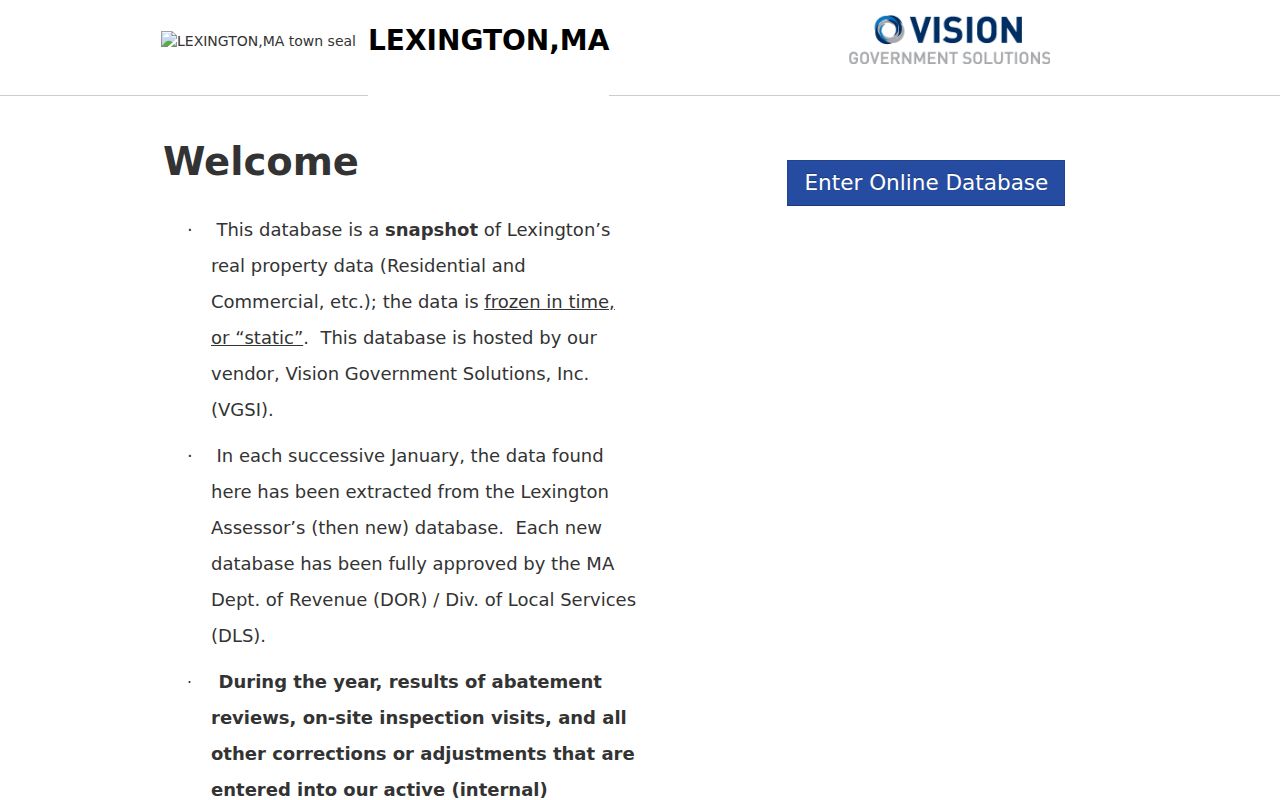
A conflicting Registry date is not necessarily an error, thanks to the annual-snapshot lag.
MapGeo Locates Lexington Resident Parcels
Lexington’s MapGeo property viewer adds map context to the assessor card. Select a parcel. Note the map date and parcel label. A question may involve a shared boundary or nearby land. Inspect abutting parcels one at a time. The town GIS landing page also links to current and prior layers. It covers historical-property material, assessor maps, and a street and precinct map. Remember the map is a reference layer, not a survey. It is also not a list of people living nearby.
MapGeo shines when an address has shifted form across records. A deed may use a legal description or lot number. A card may use a street address. Recording the parcel identifier, map year, and original address wording builds a safer bridge than merging names. For a street-by-street sequence, the By Street page keeps the focus on address-keyed sources.
Middlesex Deeds Trace Lexington Names
The Middlesex South Registry index is the recorded-land layer for Lexington. Its free public search covers Recorded Land, Registered Land, Plans, and several search modes. Names can be narrowed by first, middle, or last name. Party role, document type, town, and recorded-date range narrow it further. Property, book, document, plan, and unindexed routes each answer different questions. Common surnames need a Lexington town filter plus a date window. Otherwise a result set can hit the portal’s first 1,000 rows.
A result row is only an index lead. Open the image before treating a name as evidence. The instrument may contain grantor, grantee, and recording date. It may also hold the legal description, consideration, prior-deed reference, and plan reference. A trust, estate, company, or attorney can appear as a party too. Scanned books have not wiped out the historical fallbacks. Older microfilm, paper books, and legacy grantor or grantee indexes may still be needed. An online query sometimes runs thin.
- Grantor
- The party conveying an interest in a recorded document.
- Grantee
- The party receiving that interest.
- Parcel
- A mapped unit of land with identifiers used by local records.
- Index
- A finding tool that points to the underlying document or image.
Lexington Current Resident Sources
Current-looking sources each answer one narrow question. Vision and MapGeo tie an owner line to a parcel as of a stated snapshot. The voter-status form lets one voter check a personal registration, not browse Lexington names. A court docket names a party and role, not an address history. Business and license filings can reveal a formal role. That role sits within an organization. Their office or agent address is not always a residence. Read each record by its source label and date.
| Source | What it can confirm | Custodian | Access path |
|---|---|---|---|
| Vision property card | Parcel association and annual owner line | Lexington Assessor | Public online snapshot |
| MapGeo parcel viewer | Parcel geometry, layers, and abutters | Lexington GIS | Public dynamic viewer |
| Recorded-land index | Document parties and recording metadata | Middlesex South Registry | Public index and images |
| Voter status | A voter’s own registration status | Secretary of the Commonwealth | Name, birth date, ZIP, agreement |
| Public docket | Case party, role, court, and status | Massachusetts Trial Court | Portal and clerk route |
Lexington Voter Lookup Limits
The Secretary of the Commonwealth runs a voter-status lookup built for self-verification. You supply a first and last name and a full birth date. Add a five-digit residential ZIP code and a checkbox agreement. That design makes it a personal status check. It is not a public Lexington residents directory, and it cannot be browsed like one. Lexington's annual street list is a separate record. It links a street range to a precinct and a ZIP code directory. Yet it never becomes an open roster of who lives in town.
Confidential voter registrations stay withheld under M.G.L. c.51, §51A and its regulations. Treat gaps carefully. An address mismatch, a precinct change, or absence from a geography list proves nothing about protected status. For annual-register questions, the Town Clerk is the right fallback. Ask for a specific record that is legally public. Let the office set format and redactions.
The state form illustrates the identity controls. These separate a self-check from an open browse tool.
A ZIP code entered on that form comes from the voter. It should not be copied into any directory entry.
Lexington Court Lookup Needs Context
Local Lexington cases travel the Concord Division route. But the public search runs statewide through MassCourts. The portal offers department, division, location, and results controls. Tabs cover Name, Case Type, Case Number, and Ticket or Citation. Civil name searches demand the prescribed first and last name entries. Case-type date searches span just one month at a time. Remote access varies by case. A public docket is also not always the complete file.
A docket tells you a case number, court location, and party role. It also covers filing date, type, and status. Compare that result against independent, dated records where lawful. Court clerks hold the public hard-copy route for many documents. Sealed, impounded, juvenile, adoption, and other protected material stays off limits. A name match alone proves neither identity nor current Lexington residence.
The MassCourts entry screen shows the public starting point for a court-specific lookup.
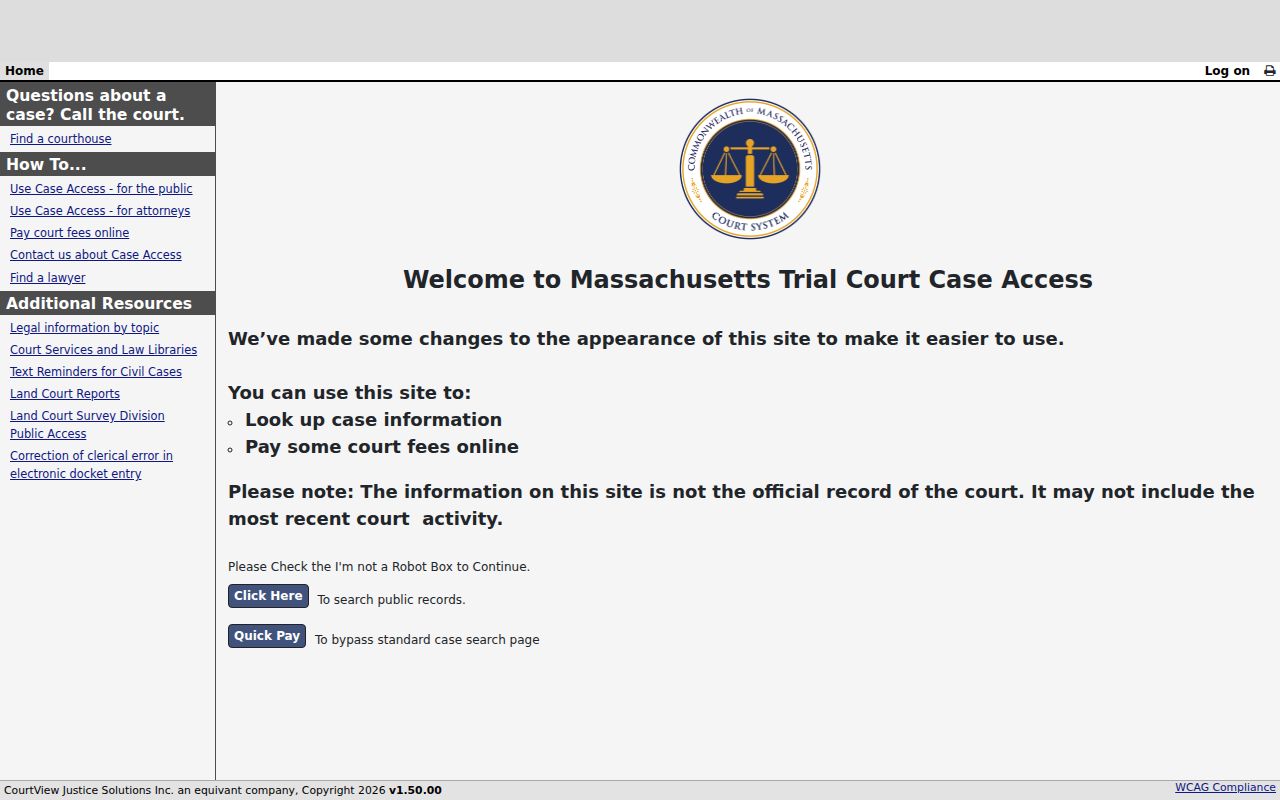
Use the court and case details on display to request the right file from the clerk, when public access rules permit.
Lexington Historical Resident Directories
Old city directories sit apart from current records. The State Library lists Lexington directory holdings across an 1887 to 1997 range rather than one continuous annual run. Years on that list include 1890, 1894, 1899, 1902, 1906, 1908, 1913, 1915, 1918, 1922, 1924, 1926, 1928, 1930, 1932, 1934, and 1942. NARA separately lists 1930, 1932, and 1934 volumes. Verify each volume before trusting its coverage.
An alphabetical entry puts a name at an address. A house guide works in reverse, leading from an address to a household. Neither entry proves ownership. Nor does it fix a move date. Household membership stays unclear too, so pair the entry with a directory year, a newspaper page, a town report, a vital record, or a recorded document. The City Directories page describes the local collections and how to read them in depth.
| Collection route | Best use |
|---|---|
| State Library directories | Selected Lexington alphabetical and house-guide volumes |
| Cary Lexington Collection | Town reports, voting lists, street directories, yearbooks, and family-history material |
| Digitized newspapers | Discovery by name, street, place, or event, followed by scan review |
| History Museums | Staff-assisted archival verification and physical collections |
Lexington Archives Preserve Local Context
Three Lexington repositories share one portal. The Lexington Heritage portal links Cary Memorial Library, Town Archives, and Lexington History Museums, while each collection remains its own. Cary's home-history guidance reaches widely. It points to CRS, Town Archives material, neighborhood resources, and historical collections.
The History Museums hold over 20,000 items. Their collection runs from the seventeenth century forward, and appointments are generally requested for research. A research request can take about three weeks. A short consultation precedes the paid research tiers.
The digitized newspaper portal adds another layer, with Lexington Minute-Men running from 1871 to 1975 and other titles covering shorter periods. Search a surname, then a street, and open the page image itself. OCR misreads initials, house numbers, and even Massachusetts Avenue. Newspapers are discovery evidence, not proof. For a formal fact, use an underlying deed, court record, vital record, or town document.
Note: A quiet result in one Lexington repository does not mean Cary, Town Archives, or History Museums lack material on the same name or property.
Dates Keep Lexington Records Honest
Dates do a lot of work in Lexington records. The Town Archives hold property and town-history material going back to 1729. Statewide vital records start in 1841. Records from 1841 through 1935 sit with the State Archives, while anything from 1936 onward follows RVRS access rules. Be careful with street names: an 1857 street-naming report warns against forcing a modern name onto an older directory entry or deed. GIS layers are listed from 2009 forward. Permit summaries span 2020 through 2026.
Every date answers its own question. A January Vision extraction is a property snapshot. A Registry recorded date marks a document event. A city-directory year pins an entry to one publication, and a newspaper issue date identifies a printed report. When records disagree, keep both the source and the date. The mismatch may point to a move, a sale, a street that changed form, an archived item, or a lag in reporting rather than an outright error.
| Period | Lexington research route | What to label |
|---|---|---|
| 1729 onward | Town Archives and property history materials | Collection and item date |
| 1841-1935 | Massachusetts Archives vital series | Event and request era |
| 1857 | Street-naming report and historic maps | Historic street form |
| 2009 onward | Prior GIS layers | Map year and layer |
Privacy Rules Limit Lexington Searches
Public access is not a license to build a private dossier. Massachusetts shields confidential voter registrations. It also shields participants in the Address Confidentiality Program, restricted vital records, sealed court material, juvenile information, and sensitive identifiers. The Address Confidentiality Program gives eligible participants a substitute address and mail forwarding. Registry standards also require redaction of full Social Security numbers from public land records.
Need a correction or a suppression? Contact the office that created or published the record. Lexington's public-record process covers existing records, not new lists of people. Label your sources. Keep personal details to a minimum. Preserve uncertainty when a record supports only a parcel, an organizational role, or a historical entry. Save the custodian's response along with the record date for later reference.