
Choose a Lexington Residents Trail
Lexington keeps no universal public name list. A useful search starts with the fact already in hand. For a house number, the annual assessor card and the parcel map are practical first checks. For a recorded transfer, the Middlesex South index can connect parties, dates, documents, and property references. For an earlier household, a city directory, town report, newspaper, or archive may be stronger evidence. The record type tells you both what the result means and what it cannot prove. An owner line, for example, is not the same thing as a confirmed occupant.
Keep a small source note as you search. Record the portal or collection, the date shown on the item, and the field that supplied the connection. That makes it possible to compare an older directory entry with a later deed or assessor snapshot without silently blending their dates. Where an item is unavailable online, Lexington accepts focused Massachusetts Public Records Law requests through OpenGov, mail, email, or an in-person route. Ask for an existing series by address, date range, or document type; a custodian does not have to create a new resident compilation.
- Start an address question with the Vision property record and MapGeo parcel view.
- Use the Middlesex South index to inspect a deed, plan, or recorded document tied to that parcel.
- For a name, test the relationship in a dated source rather than assuming a current residence.
- Use historical collections when the question concerns an earlier household or street.
- Ask the responsible office for a narrow record when the public portal does not hold the item.
Lexington Offices Behind Resident Records
Different Lexington resident records belong to different custodians. The Town Clerk is the local counter for vital records, business certificates, elections, town archives, and public-records intake. The Assessor maintains property cards and the annual Vision snapshot. Middlesex South handles recorded land in the registry district that includes Lexington. Statewide systems take over for court dockets, voter self-checks, and many vital-record requests. Use the office that created the record, not a broad name search, when a fact needs confirmation.
Middlesex South Registry of Deeds
208 Cambridge Street
Cambridge, MA 02141
617-679-6300
Lexington Assessor
1625 Massachusetts Avenue
Lexington, MA 02420
781-698-4578
Lexington Town Clerk
1625 Massachusetts Avenue
Lexington, MA 02420
781-698-4558
Concord District Court serves Lexington for local district matters, while Middlesex Superior and Probate courts may hold other case files. The office card identifies the administrative starting point; it does not turn separate records into a single resident roll.
Vision’s Lexington Property Directory
The Lexington Assessor’s Online Property Database is an address and owner-oriented record route. The town states that the public version is a January annual extract, so a later deed or active assessment change can appear elsewhere first. A property card can supply a Vision ID, Map ID, situs address, owner line, assessment information, and ownership-history clues. Some cards also show a care-of or mailing line. Label that field as a mailing line instead of treating it as the address where a person lives.
| Vision field | Search use | Important limit |
|---|---|---|
| Owner or street address | Find the annual parcel card | Snapshot, not a live transfer feed |
| Vision ID and Map ID | Connect the card to map and property research | Preserve the year shown |
| Book or page clue | Open a matching Registry document | Confirm the instrument image |
| Situs or care-of field | Separate parcel location from a mailing notation | Neither proves daily occupancy |
The assessor search screen shown below is the starting interface for this Lexington residents directory route. Check the card’s print or assessment year before comparing it with any deed.
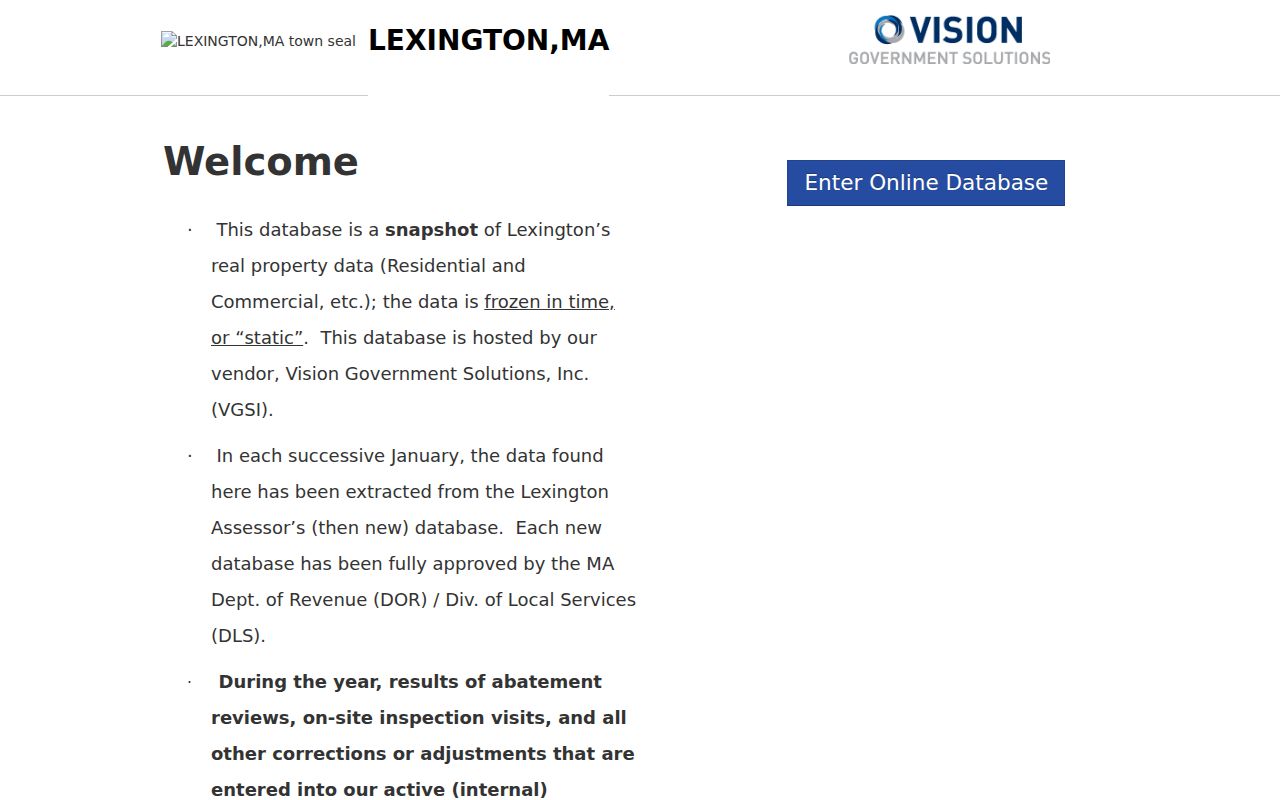
The annual-snapshot warning is why an apparently conflicting Registry date can be useful rather than an error.
MapGeo Locates Lexington Resident Parcels
Lexington’s MapGeo property viewer adds map context to the assessor card. Select a parcel, note the map date and parcel label, then inspect abutting parcels one at a time when the question concerns a shared boundary or nearby land. The town GIS landing page also points to current and prior layers, historical-property material, assessor maps, and a street and precinct map. The map is a reference layer, not a survey and not a list of people living nearby.
MapGeo is especially useful when an address has changed form across records. A deed may use a legal description or lot number while a card uses a street address. Recording the parcel identifier, map year, and original address wording provides a safer bridge than trying to merge names. For a complete street-by-street sequence, the By Street page keeps the focus on address-keyed sources.
Middlesex Deeds Trace Lexington Names
The Middlesex South Registry index is the recorded-land layer for Lexington. Its free public search offers Recorded Land, Registered Land, Plans, and several search modes. Name work can be narrowed by first, middle, or last name, party role, document type, town, and recorded-date range. Property, book, document, plan, and unindexed routes serve different questions. Common surnames need a Lexington town filter and a date window because a result set can reach the portal’s first 1,000 rows.
A result row is an index lead. Open the image before treating a name as evidence. The instrument may contain the grantor, grantee, recording date, legal description, consideration, prior-deed reference, and plan reference. A trust, estate, company, or attorney can also appear as a party. The registry’s scanned books do not eliminate historical fallbacks: older microfilm, paper books, and legacy grantor or grantee indexes may still be needed when an online query is thin.
- Grantor
- The party conveying an interest in a recorded document.
- Grantee
- The party receiving that interest.
- Parcel
- A mapped unit of land with identifiers used by local records.
- Index
- A finding tool that points to the underlying document or image.
Lexington Current Resident Sources
Current-looking sources answer different questions. Vision and MapGeo can associate an owner line with a parcel as of a stated snapshot. The voter-status form is intended for a voter to check their own registration, not to browse local names. A court docket identifies a case party or role, not an address history. Business and license records can identify a formal organization role, but their office or agent address is not necessarily a residence. Treat each item by its source label and date.
| Source | What it can confirm | Custodian | Access path |
|---|---|---|---|
| Vision property card | Parcel association and annual owner line | Lexington Assessor | Public online snapshot |
| MapGeo parcel viewer | Parcel geometry, layers, and abutters | Lexington GIS | Public dynamic viewer |
| Recorded-land index | Document parties and recording metadata | Middlesex South Registry | Public index and images |
| Voter status | A voter’s own registration status | Secretary of the Commonwealth | Name, birth date, ZIP, agreement |
| Public docket | Case party, role, court, and status | Massachusetts Trial Court | Portal and clerk route |
Lexington Voter Lookup Limits
The Secretary of the Commonwealth’s voter-status lookup asks for first name, last name, month, day, year of birth, a five-digit residential ZIP, and an agreement checkbox. It is an individual verification tool, not a public Lexington residents directory. Lexington’s annual street list is a different record: it helps connect a street range to a precinct and ZIP but does not create a public online roster of residents.
Confidential voter registrations are withheld under M.G.L. c.51, §51A and related regulations. Do not use an address mismatch, precinct change, or absence from a public geography list to infer protected status. The correct fallback for annual-register questions is the Town Clerk or a focused request for a record that is legally public, with the office deciding format and redactions.
The state form below illustrates the identity controls that distinguish a self-check from an open browse tool.
A ZIP entered on that form is supplied by the voter and should not be copied into a directory entry.
Lexington Court Lookup Needs Context
Lexington’s local district route is Concord Division, but the public search is statewide through MassCourts. The portal has department, division, location, and results controls plus tabs for Name, Case Type, Case Number, and Ticket or Citation. Civil name searches require the prescribed first and last name entries. Case-type date searches are limited to a one-month window. Remote access varies, and a public docket is not always the complete case file.
Use a docket to identify a case number, court location, party role, filing date, type, and status. Then compare the result against independent, dated records where lawful. Court clerks hold the public hard-copy route for many documents, while sealed, impounded, juvenile, adoption, and other protected material remains unavailable. A name match alone does not establish identity or current Lexington residence.
The MassCourts entry screen shows the public starting point for a court-specific lookup.
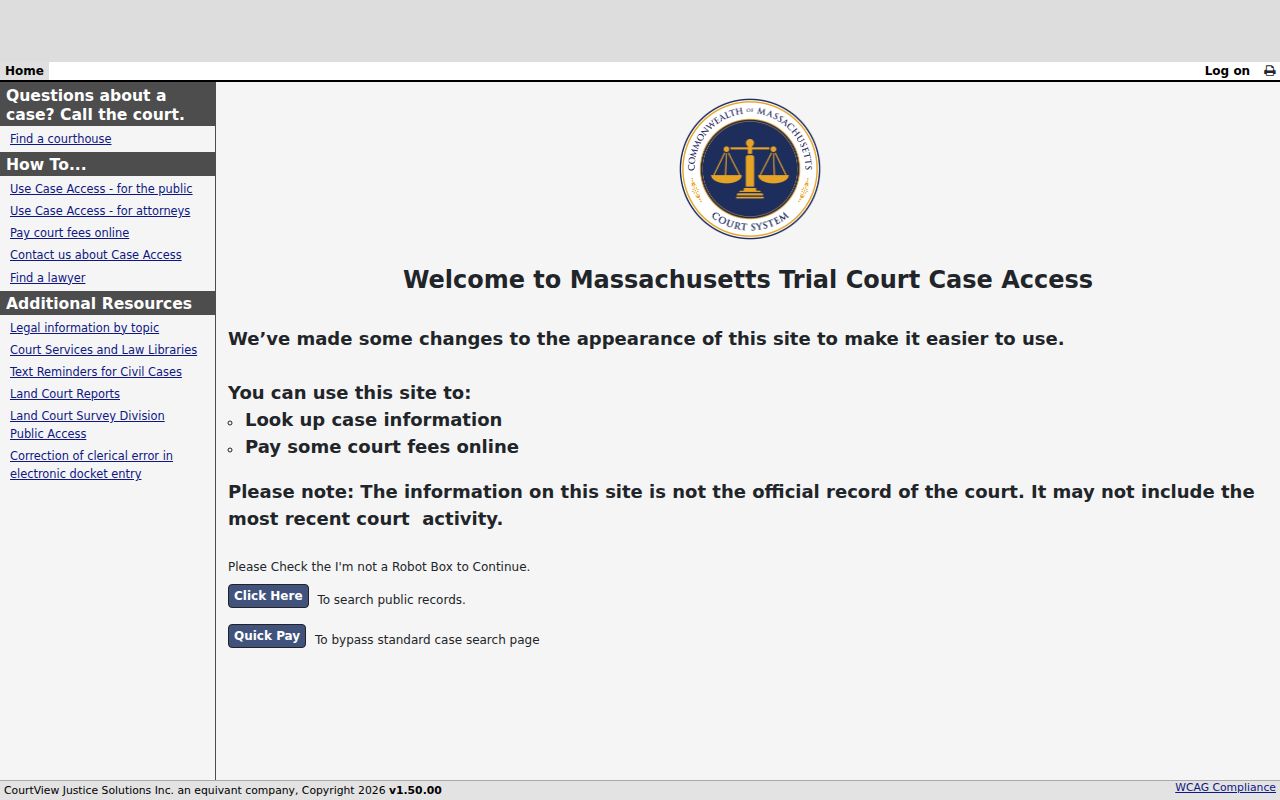
Use the displayed court and case details to request the correct file from the clerk when public access rules permit.
Lexington Historical Resident Directories
Historical city directories are a different shelf from current records. The State Library identifies selected Lexington directory holdings in an 1887 to 1997 range, not a continuous annual run. Located years include 1890, 1894, 1899, 1902, 1906, 1908, 1913, 1915, 1918, 1922, 1924, 1926, 1928, 1930, 1932, 1934, and 1942. NARA separately identifies Lexington directories for 1930, 1932, and 1934. Verify each volume before relying on its coverage.
An alphabetical entry can place a name at an address in a particular issue. A house guide can point from an address to a household. Neither automatically proves ownership, a move date, or every member of a household. Pair the entry with a directory year, a newspaper page, a town report, vital record, or recorded document. The City Directories page describes the local collections and how to read them in depth.
| Collection route | Best use |
|---|---|
| State Library directories | Selected Lexington alphabetical and house-guide volumes |
| Cary Lexington Collection | Town reports, voting lists, street directories, yearbooks, and family-history material |
| Digitized newspapers | Discovery by name, street, place, or event, followed by scan review |
| History Museums | Staff-assisted archival verification and physical collections |
Lexington Archives Preserve Local Context
The Lexington Heritage portal links Cary Memorial Library, Town Archives, and Lexington History Museums, but the collections remain distinct. Cary’s home-history guidance points to CRS, Town Archives material, neighborhood resources, and historical collections. Lexington History Museums holds more than 20,000 items from the seventeenth century forward and generally asks researchers to arrange an appointment. Its research-request process can take about three weeks, with a short preliminary staff consultation available before paid research tiers.
The digitized newspaper portal provides another local layer. Lexington Minute-Men runs from 1871 to 1975, and other Lexington titles cover shorter periods. Search a surname and a street separately, then inspect the page image because OCR may misread initials, house numbers, and Massachusetts Avenue. Newspapers are good discovery evidence; use an underlying deed, court record, vital record, or town document when a formal fact must be confirmed.
Note: A quiet result in one Lexington repository does not prove that Cary, Town Archives, or History Museums lack material on the same name or property.
Dates Keep Lexington Records Honest
Lexington’s record trail crosses several time boundaries. Town Archives material reaches back to 1729 for some property and town-history work. Massachusetts statewide vital records begin in 1841, while 1841 to 1935 records belong with the State Archives and 1936-present records follow RVRS access rules. The town’s 1857 street-naming report is a warning against projecting a current street name into an older directory or deed. Prior GIS layers are listed from 2009 forward, and permit activity summaries cover 2020 through 2026.
Each date answers a different question. A January Vision extraction is a property snapshot. A Registry recorded date marks a document event. A city-directory year places an entry in one publication. A newspaper issue date identifies a printed report. Retain both source and date when records disagree. The disagreement may reflect a move, a sale, a changed street form, an archived item, or a reporting lag rather than an error.
| Period | Lexington research route | What to label |
|---|---|---|
| 1729 onward | Town Archives and property history materials | Collection and item date |
| 1841-1935 | Massachusetts Archives vital series | Event and request era |
| 1857 | Street-naming report and historic maps | Historic street form |
| 2009 onward | Prior GIS layers | Map year and layer |
Privacy Rules Limit Lexington Searches
Public access does not authorize a private dossier. Massachusetts protects confidential voter registrations, Address Confidentiality Program participants, restricted vital records, sealed court material, juvenile information, and sensitive identifiers. The Address Confidentiality Program provides a substitute-address and mail-forwarding service for eligible participants. Registry standards also require redaction of full Social Security numbers from public land records.
For a correction or suppression issue, contact the office that created or published the record. Lexington’s public-record process is for existing records, not an instruction to assemble a new list of people. Use source labels, minimize personal details, and preserve uncertainty when a record only supports a parcel, organizational role, or historical entry. Save the custodian’s response with the record date for future reference.